

Our Client Family’s Memo for the Cemetery Office: An Explanation of Qingming in America

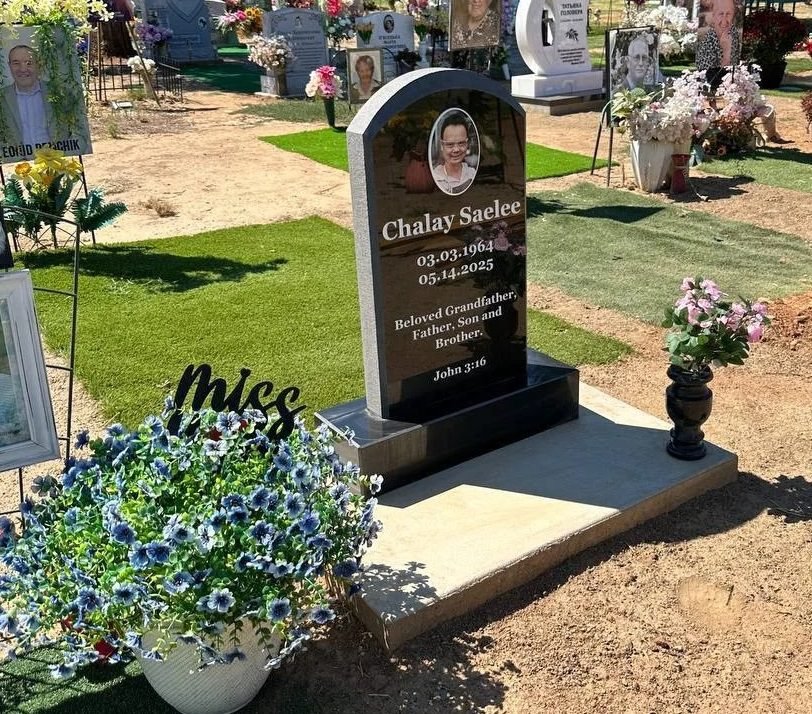
A couple of years ago, we came across a memo written by a client family, and we received their permission to publish it because we found it very helpful in understanding the tomb-sweeping ritual better than any encyclopedia. Following some misunderstanding during one April (the groundskeeper in question, meaning no harm, cleared all offerings from the grave of their grandfather a few hours after those were made) the oldest daughter in the family sent a one-page memo to the cemetery office explaining what her family would be doing at the grave each year and why and how they could distinguish devotion from litter. The cemetery office put it up on the bulletin board in the break room. There has been no misunderstanding since then and three other families have already asked for a copy of it. Here is the memo in its full glory along with our commentary in between sections, as monument dealers should understand Qingming as well as the mowing crew at one very enlightened cemetery does.
The memo starts off with “To the grounds staff, with thanks.” “You will see our family at Section 8, Lot 214, in early April every year, usually on the first weekend of the month. There may be ten of us. We will be there for most of the day. This letter explains what we are doing so it will never look mysterious.” Our commentary: the timing is very important. Qingming – the name means something like “clear brightness” – comes in early April, fifteen days after the spring equinox, and is the great tomb-sweeping festival celebrated by Chinese families worldwide, alongside such similar festivals as Thanh Minh of Vietnam and many other East and Southeast Asian ones. In simple American terms, it is the official family day at the cemetery, as clear on the calendar as any holiday the grounds crew already knows, and busier at the gravesite than most of them.
The memo goes on to say “First we clean. That is the whole name of the holiday.” “We will bring brushes, cloths and water. We wash the headstone, pull weeds by hand, trim the grass edge around the marker, and clean up the whole plot. Grandfather was particular. We keep his standards.” Our commentary: tomb-sweeping is literal and it is the core of the tradition – all the weather of the year is being cleaned off of the grave by the hands of the family and a clean, bright stone is the proof that the dead are respected and the family is in good shape. The monument implications are direct and we design for them: washable polished granite faces, deeply cut characters and letters that would keep their sharpness through decades of annual cleaning, designs without moisture-attracting crevices. The stone that is easy to clean is not a maintenance convenience in this tradition. It is the ritual tool and the family’s day depends on its performance.
The memo continues “Then we offer food, and we burn incense. Please do not remove these while we are present or on the same day.” “You will see oranges, a whole chicken or roast pork, tea poured in small cups, rice, and Grandfather’s cigarettes, which Grandmother disapproves of and brings anyway. Incense sticks will burn in a holder we will bring or in the granite bowl that is part of the new headstone. We take the food with us when we leave – it is shared by the family afterwards. Anything left by the evening can be cleared with our thanks.” Our commentary: offerings are the heart of the visit – the meal offered to the ancestors, starting with the senior generations, and the incense burning showing respect to the dead – and the memo gently mentions the design element that changed the family’s ritual: the granite bowl that is part of the new headstone. When this family replaced the original flat marker of their grandfather with a whole family stone, they ordered what the tradition-fluent monuments include: the granite bowl for the incense to burn in, the offering ledge at the bottom wide enough for the offerings to stand on, and the design expecting the annual meal. The improvised tables of their previous Qingmings were gone that April. The stone knew the family’s calendar.
The memo moves on “About the paper you may see burning.” “Our tradition includes burning spirit money and paper goods so that our ancestors can have everything they need. We know that fire rules are very serious here. We use a covered metal container, we bring water, and where the cemetery’s policy doesn’t allow burning at the gravesite, we complete this part of the ritual at home or at our association’s designated site. We just ask that you let us know the policy so that we can observe it.” Our commentary: this paragraph is the masterpiece of the memo’s diplomacy and the model for how tradition and regulation should meet politely. Burning offerings is the real and very important practice but the fire policy differs from cemetery to cemetery and from state to state; and the answer is never any improvisation – it is always asking, politely and in advance. This is one of the reasons we check cemetery regulations directly with each office before a monument design is started: the family designing the stone for the ritual involving incense, offerings and burning paper should know their ground in advance, not the first April.
The memo continues: “The new generation will be there too.” “You will see our children at the grave doing what we did at their age: bowing three times with incense, placing Grandfather’s teacup, listening to the same three stories and complaining about the same early start. This is the point of the whole day. Please forgive any running.” Our commentary: Qingming is transmission – the visit is where ancestors are introduced to descendants who have never met them before, and this means one more thing from the monument itself: it should be legible through generations and languages. The stones we create for such families increasingly carry two scripts – the family name large in characters, the inscriptions bilingual as one design, two dates if requested – with native reader’s approval of every character at full size before the production as our standard practice. The grandchildren mentioned in the memo will read whatever alphabet their schools taught them. The stone should respond to both.
And the memo finishes off with “Thank you for taking care of this ground. On the first weekend of April, we will be taking care of it with you.” Our final commentary only needs to broaden the memo’s circle of recipients. To grounds crews: this is what you see each early April and it is not neglect – it is the best-tended day of the year at the cemetery. To Chinese, Vietnamese and other observing families: the demands of your tradition are designable – polished washable granite, the incense and offerings elements incorporated into the stone, the bilingual design with native review, the flush-section adaptations if lawns are required – and our counter creates such stones every day, with engraving included in each quoted price, with shipping paid for, cemetery regulations checked in advance, with a free 3D preview and revisions till the family and their elders approve, and 0% installment plans. And to the daughter who wrote this memo: your one page accomplished more for mutual understanding than a book of pamphlets ever will. The grave is swept. The tea is poured. The letter, like the stone, works each April.
