

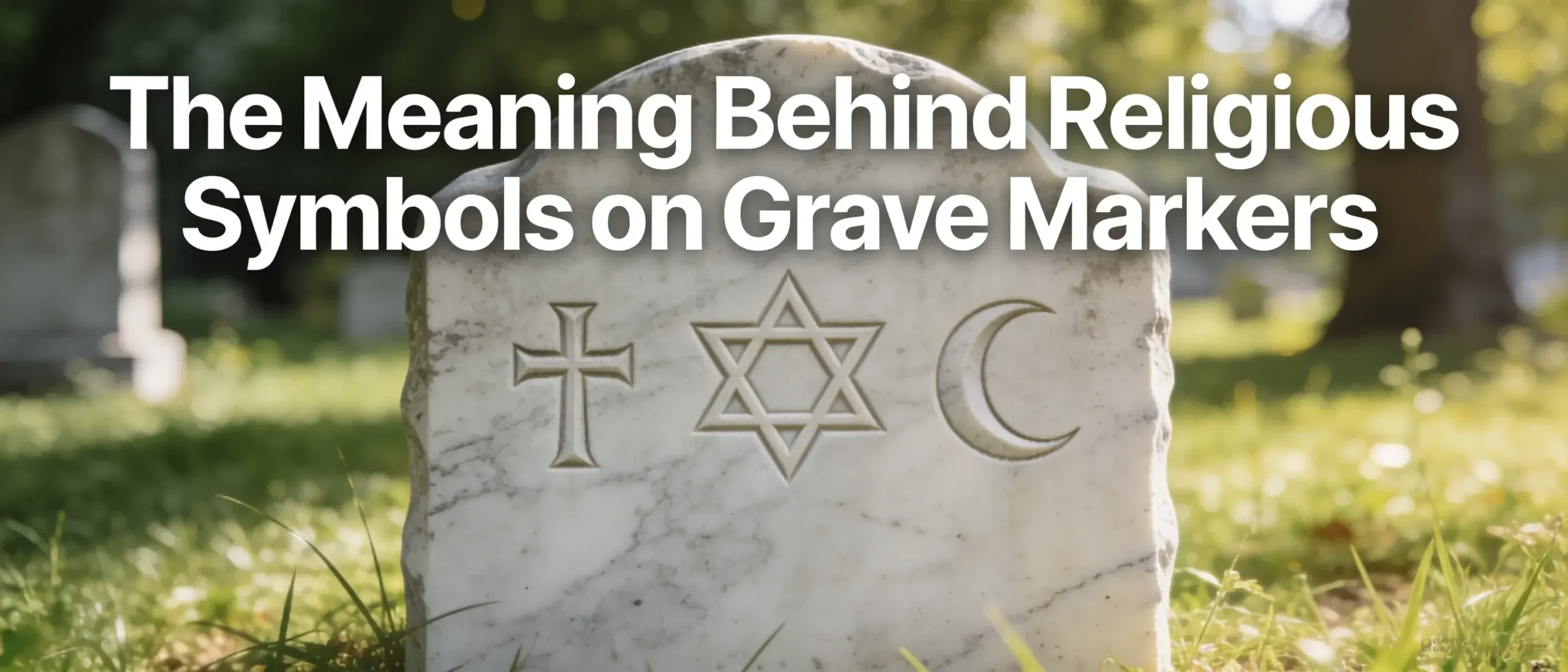
The Meaning Behind Religious Symbols on Grave Markers

By Capital Grave Markers Editorial Team · Updated 2026-07-09
A grave marker does far more than record a name and a date. For many families, the symbol engraved on a headstone is the single most important detail — a permanent, visible declaration of the faith their loved one carried throughout life. Religious symbols on grave markers communicate belief, heritage, and hope to every visitor who passes by, for generations to come.
Whether a family is selecting a marker for the first time or researching the meaning behind a symbol they have seen in a cemetery, this guide explains what the most common religious emblems represent, how each major faith tradition uses them, and how families can choose confidently before engraving begins.
Key Takeaways
- Religious symbols on grave markers communicate a deceased person’s faith, values, and spiritual identity to visitors for generations.
- The U.S. Department of Veterans Affairs maintains over 100 national cemeteries with strict headstone symbol guidelines — families must verify approval before ordering.
- Common religious symbols include crosses, Stars of David, crescents, and dharma wheels, each representing distinct major world faith traditions.
- Capital Grave Markers provides a complimentary design proof and 3D visualization so families confirm every detail before any engraving begins.
- All markers are American-made and hand-finished by skilled engravers, with transparent pricing that includes engraving and shipping to the lower 48 states.
What Do Religious Symbols on Grave Markers Mean?
Religious symbols on grave markers communicate a deceased person’s faith, hope, and core beliefs to future generations. Choosing the right symbol — and rendering it accurately — is one of the most meaningful decisions a family makes during the memorial process. Omitting it, or selecting one that does not match the individual’s tradition, leaves a permanent gap in the story the marker tells.
Each symbol carries a distinct meaning rooted in centuries of tradition. Some of the most widely recognized include:
- Angel — represents divine protection and guidance, particularly the soul’s journey toward Heaven
- Arch — signifies the passage from this life into the next; a threshold between the earthly and the eternal
- Cross — the central emblem of Christian faith, representing sacrifice, resurrection, and the hope of eternal life
- Star of David — a defining symbol of Jewish identity and heritage
- Crescent and Star — associated with Islamic faith and widely used on Muslim grave markers
- Dharma Wheel — represents the Buddhist path and the cycle of life, death, and rebirth
- Dove — conveys peace, purity, and the Holy Spirit across several Christian denominations
- Lamb — used most often on children’s headstones to express innocence and God’s protection
Understanding the full range of common headstone symbols and their meanings helps families narrow their selection before speaking with a memorial specialist.
Why Do Different Faiths Use Different Symbols on Headstones?
Different religious traditions express distinct theological beliefs through unique visual language. A cross and a Star of David are both expressions of deep faith — but they speak to entirely different histories, communities, and worldviews. Using the wrong symbol, even unintentionally, can cause lasting distress for a grieving family.
Capital Grave Markers offers cultural and religious designs spanning Christian, Jewish, Muslim, and other traditions, allowing families to select imagery that aligns precisely with personal faith and denominational preference. Every design is reviewed with the family before production, so there is no guesswork and no risk of an irreversible mistake.
How Do Families Choose the Right Religious Symbol for a Grave Marker?
The process starts with identifying the faith tradition and any denomination-specific imagery meaningful to the individual being honored. A few practical steps help families choose with confidence:
- Identify the tradition — Christian, Jewish, Muslim, Buddhist, or another faith — and research the symbols most closely associated with it.
- Consider denomination — within Christianity alone, a Latin cross, Orthodox cross, Celtic cross, and anchor cross each carry different denominational associations.
- Review a design proof — seeing the symbol rendered at actual scale and in the chosen granite color confirms that the final result will match the family’s vision.
- Verify cemetery requirements — many regulated cemeteries restrict which symbols are permitted on markers; compliance must be confirmed before production begins.
Capital Grave Markers walks families through each of these steps, including hands-on support with cemetery rules and compliance — a critical detail that is easy to overlook during a difficult time.
Which Faith Traditions Use Specific Grave Marker Symbols?
Religious symbols on grave markers vary meaningfully across faith traditions. Several major traditions maintain distinct visual vocabularies that families and memorial providers must understand before any design is finalized.
Christian Symbols on Headstones
The cross is the most universally recognized Christian emblem, but it is far from the only one. Doves, anchors (representing hope and steadfast faith), resurrection imagery, and the Chi-Rho monogram all appear on Christian headstones, often reflecting the specific denomination or personal devotion of the individual. Designing a memorial for a religious cemetery requires matching the symbol not just to the broader faith but to the family’s specific tradition within it.
What Symbols Appear on LDS Grave Markers?
LDS grave markers serve as enduring symbols of faith, family, and eternal life for members of The Church of Jesus Christ of Latter-day Saints. Temple engravings are among the most recognizable motifs, representing sacred covenants and the promise of eternal life that is central to the faith. Angel Moroni imagery and CTR (Choose the Right) shields may also appear, each carrying specific theological significance within the LDS tradition.
What Symbols Does the VA Permit on Veterans’ Headstones?
The U.S. Department of Veterans Affairs restricts graphics on government-furnished headstones and markers to an approved list of emblems of belief. That list is extensive — recognizing dozens of religious and belief traditions — but families must confirm their chosen symbol is on it before finalizing any design. Selecting a symbol that falls outside the approved list will delay or prevent production of a government-furnished marker.
Faith traditions with documented grave marker symbols include:
- LDS (Latter-day Saints): Temple imagery, covenant-related motifs, Angel Moroni
- Christian: Crosses, doves, anchors, and resurrection imagery
- Jewish: Star of David, menorahs, and Hebrew inscriptions
- Muslim: Crescent and star motifs, Arabic calligraphy
- Buddhist: Dharma wheel, lotus flower
- Veterans of all faiths: VA-approved emblems of belief
Capital Grave Markers produces memorials crafted in America and hand-finished by skilled engravers, ensuring accurate and respectful rendering of each tradition’s symbols across every order.

How Can Families Choose the Right Religious Symbol?
Selecting a religious symbol for a grave marker is both a practical and deeply personal decision. Each symbol carries a traditional meaning — but a family’s own history and beliefs shape how that symbol reads on a specific marker. A cross, a Star of David, or a crescent may hold layers of meaning unique to the individual being honored, beyond what any general guide can capture.
Does a Symbol’s Meaning Change From Family to Family?
The definitions covered in this guide represent the most widely recognized interpretations. In practice, families sometimes adapt a symbol’s meaning based on a loved one’s personal faith journey, cultural background, or even a cherished story. A family might choose an anchor not only for its Christian connotations but because their loved one was a lifelong sailor. That personal layer of meaning is entirely valid — and a good memorial specialist will take time to understand it before recommending a design.
Families benefit from discussing intended meaning with a memorial specialist before finalizing any design. Capital Grave Markers’ team is available by phone at +1 (888) 241-1701 or by email at [email protected] to answer questions about symbols, traditions, and design options at any stage of the process.
What Steps Help Families Confirm the Symbol Is Correct?
Capital Grave Markers provides a complimentary design preview and proof review before production begins. Using three-dimensional design visualization, families can see exactly how the chosen symbol will appear on the finished marker — at scale, in the selected granite color — before a single cut is made. This step eliminates the most common source of regret: discovering after delivery that the symbol was slightly wrong, too small, or not what the family envisioned.
Beyond the proof, Capital Grave Markers also offers hands-on support with cemetery rules and compliance. Many regulated cemeteries restrict which symbols are permitted on markers — a detail that can catch families off guard. Addressing this before production begins, rather than after, protects families from costly and irreversible corrections.
The two-step process — proof approval plus cemetery verification — is Capital Grave Markers’ standard practice on every order, not an optional add-on.
Ready to Honor a Life With the Right Symbol?
Choosing a religious symbol for a grave marker is one of the most lasting decisions a family will make. Capital Grave Markers combines American craftsmanship, a complimentary 3D design preview, and hands-on guidance through every step — from symbol selection to cemetery compliance — so families can move forward with confidence rather than uncertainty.
To start the process or ask a question about a specific symbol or tradition, contact Capital Grave Markers at +1 (888) 241-1701 or [email protected]. There is no obligation, and the design consultation is complimentary.
Frequently Asked Questions
What do religious symbols on grave markers communicate?
Religious symbols serve as a lasting, visible record of a person’s faith and spiritual identity. They convey theological beliefs, cultural heritage, and personal devotion to every visitor who encounters the marker — across generations. Selecting the right symbol ensures the memorial tells an accurate and meaningful story about the individual it honors.
Which religious symbols appear most commonly on grave markers?
The most common symbols include the Christian cross, the Star of David, the Islamic crescent and star, and the Buddhist dharma wheel. Beyond these, angels, doves, lambs, anchors, and temple imagery appear frequently, each associated with specific faith traditions or denominational beliefs. The right choice depends on the individual’s tradition and, in some cases, their specific denomination or congregation.
How does Capital Grave Markers apply religious symbols to its products?
Skilled engravers hand-finish each American-made marker, crafting personalized religious emblems with precision. The process includes a complimentary design proof — using 3D visualization — so families review and approve every detail before production begins. Pricing includes engraving and shipping to the lower 48 states, with no hidden fees.
Does Capital Grave Markers support veterans’ headstone symbol requirements?
Yes. Capital Grave Markers is familiar with the U.S. Department of Veterans Affairs’ approved emblems of belief and can help families confirm that a chosen symbol meets VA requirements before finalizing a design. The team also provides hands-on support with cemetery documentation and approvals, which is especially important for government-furnished markers.
What if a family is unsure which symbol is appropriate?
Families are encouraged to reach out before making any decisions. Capital Grave Markers’ memorial specialists can walk through the options associated with a specific faith tradition, explain the differences between similar symbols, and provide a design proof to help the family visualize the final result. The consultation is complimentary and carries no obligation to order.
Conclusion
Religious symbols on grave markers carry centuries of theological meaning — from the Christian cross and its promise of resurrection, to the Star of David’s declaration of Jewish identity, the Islamic crescent and star, and the Buddhist dharma wheel’s representation of life’s cycle — each emblem is a precise, lasting statement of who a person was and what they believed. Selecting the right symbol requires more than recognizing an image: it demands matching the emblem to the individual’s specific faith tradition, verifying denomination-level distinctions, and confirming that the chosen design meets the requirements of the cemetery where the marker will be placed. Getting those details right the first time matters, because an engraved headstone is permanent. Families who want to approach that decision with confidence are welcome to contact Capital Grave Markers for a complimentary design consultation — there is no obligation, and every order includes a 3D proof review before a single cut is made.
