

The Family Tree of Monument Forms: A Genealogy of All Shapes in the Cemetery, From Ancestors to Descendants

In the process of researching a monument, each family will come across such terms as “upright”, “slant”, “bevel”, “flat marker”, “ledger”, “bench” and so on, which are introduced as a lineup of strangers. But all these are not strangers. This is a family and when we draw up the tree of their descent, we can find that each shape that we know of has ancient ancestors and perfectly traced lines of inheritance. And that is what this genealogy of monument forms does: firstly, it introduces the ancestors, then the branching, marriages between the lines and their descendants in contemporary sections of cemetery. Besides, there are some comments on which kind of inheritance is good for what family because the main point of any genealogy is that. The tree starts from its most ancient names.
The founding ancestors. There are three types of monuments that are considered the founders of other forms. Each of them was created to solve the problem of how to indicate the place of burial. First of all, it is a standing stone. In other words, it is a vertical monument of the type of Jacob’s pillar over Rachel, the menhir, the stele. Secondly, there is a covering slab. It is a ledger or a full-length stone laid over the grave. And finally, there is a heap of earth and stones turned into the permanent shape. This is the cairn or tumulus. Thus, we have got such traits as announcement, coverage, and closeness to the ground. Every shape that you may know from the catalog of modern monuments is the descendant of one of these three or even a combination of two.
The tall line. Obelisks and other tall shapes of monuments inherit their qualities from the stele. The first and biggest flowering of this line is in Egypt and is the obelisk or the tapered shaft with its pyramid crown – the vertical announcement of the burial place perfectly created. The obelisk became the form that conquered all of the nineteenth-century American cemetery. There, the Victorian family plots raised the granite obelisks like prosperous towns raise their court-house clocks. The descendants of this form are also alive. These are the column and shaft monuments in the estate sections as well as the practical grandchild of the obelisk – the modern upright headstone. The upright is actually the crossbreeding of the line: the vertical surface of the ancient stele for inscription combined with the base-and-cap architecture of the obelisk. Who will inherit it well? Of course, it is the families who wish to announce something to the visitors. The inheritance of the line has one condition: the monument should answer the height rules of the cemetery where it will be erected. That is why the process of our work includes the analysis of the rules of the section before starting designing.
The horizontal line. The descendants of the covering slab kept the family trait: the full contact with the ground and dressing of the grave with stone. The ledger is alive in the direct line of descent – it is now granite and not the church floor marble, but it is the most complete inheritance. This line gives the largest inscription canvas in the catalog. Its modern children adapted to the lawn cemetery era and decreased with dignity – this is the flat marker or the compact heir of the ledger, flush with the grass and carrying the family line traits: the immutability, humility, immunity to the wind and rules, as well as the most accessible prices in memorial work. One of the most interesting crossings in the line is the ledger-with-headstone pairing, that is the covering slab wedded to the small standing stone at the head of the grave. Reuniting of the tree’s two oldest branches in this case is similar to the action of old families. Who will inherit it well?These are the understated, maintenance-minded families and those who are in a flat-only section – this is not the lower inheritance but the oldest inheritance in the new dressing.
The middle branch. Slant markers and bevel markers. The most American branch of the tree that appeared in the last century and a half as the result of the crossing of the lines. The slant marker is the standing stone’s trait of readable presence crossed with the mound line’s low stability: a wedge of granite with the angled face for better inscription, stable against the weather and mower, tall enough to be read standing and low enough to pass the rules. The bevel markercrosses towards the horizontal – this is the low block of granite with the slightly sloping top. This form is the flat marker’s humility with just a bit of elevation needed for drainage and visibility. The middle children inherited the line traits very shrewdly, which is why they occupy the places in the new sections. They are the compromise heirs of the tree and like all compromise heirs, they quietly govern the estate. Who will inherit them well? Actually, most families will do it because these formats were invented exactly because most needs live in the middle. They carry all the inheritance of engraving, emblems and portraits that the older lines developed.
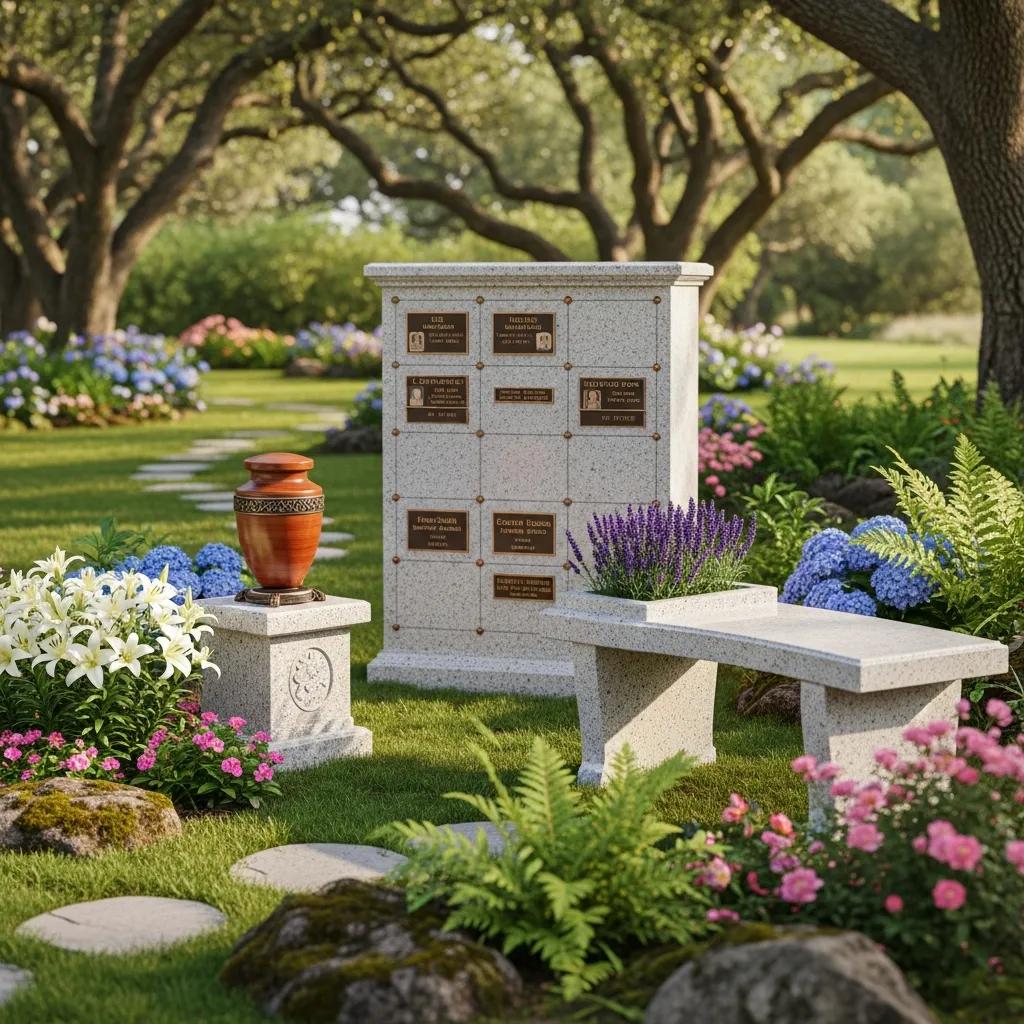
The seated line. Bench. One more branch that was grafted to the tree from the outside – the memorial bench comes from the garden and civic furniture, commemorative seats and donated park benches, and was married into the monument family recently. It brought a dowry that was not available to other lines: function. The bench is the only form on the tree that serves for the visitor, and the development of the form corresponds with the development of the visiting culture: families who visit often and stay long and want the monument to host them. Some bench models have interior cremation chambers and represent the seat becoming the place of rest. Who will inherit them well? This is the families of long visits, the majority of those who have chosen cremation and those, whose person would say about the whole solemn catalog: “just give people somewhere to sit.”
Reading your inheritance. Genealogies always start with the living, so if you stand in the modern cemetery section and look around, you will see the upright from the tall line, the flat markers keeping the promise of the ledger on the lawn level, the slants and bevels running the middle estate, a bench hosting a family and, from time to time, a Victorian obelisk – the great-grandfather who is still alive and standing in the line of descendants. When choosing between these monument forms, you should remember that it is not a matter of style but of joining the line, and the genealogist’s advice to the family historian is the same: choose the ancestor whose way of being remembered matches your way of remembering. Announcement, coverage, closeness, compromise or seat. Our counter keeps the whole tree of the forms in granite – every branch on it, in the full range of colors and formats, with the free 3D preview and revision rounds to see your name in your chosen line, engraving included in each listed price, delivery free, cemetery rules agreed with your office up front and 0% installment plans across every inheritance. Five thousand years of forms, one family tree, and room on it – this is the genealogy’s last and best line – for exactly one more name.
