

Granite Flat Headstones Why Granite Is the Standard Material

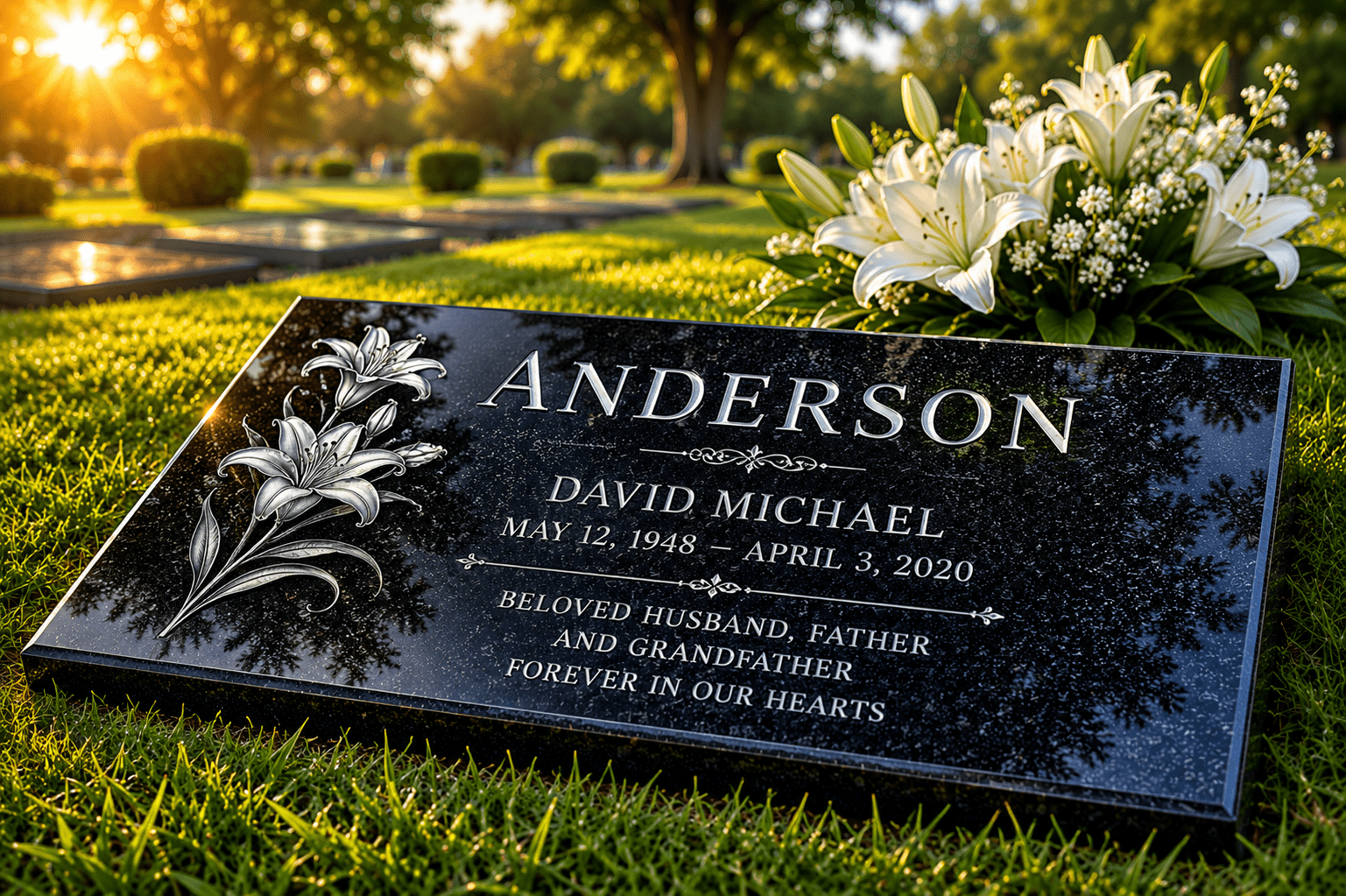
When you are making decisions about a memorial for someone you love, the last thing you want is to spend hours researching materials and wondering if you are making the right choice. Most families come to us with some version of the same question: why does everyone use granite? Is it actually the best option, or is it just what the industry defaults to?
The short answer is that granite earned its position as the standard material for flat headstones through performance, not convention. It is not simply tradition. It is the result of a material that has proven itself in outdoor cemetery environments across every climate in the country, decade after decade, in a way that no other option has matched.
This guide covers why granite consistently outperforms alternatives for flat grave markers, how different granite colors and finishes affect both appearance and longevity, what the engraving and customization process actually looks like, and how to make a confident decision when ordering a granite cemetery marker for someone you care about.
What Makes Granite the Go-To Choice for a Flat Headstone
Granite is an igneous rock formed under extreme pressure and heat deep in the earth. That geological process produces a material with a specific combination of properties that makes it uniquely well-suited for outdoor memorials that need to survive for generations without significant maintenance.
The characteristics that matter most for a flat headstone are hardness, resistance to weathering, and the ability to hold fine detail engraving over time. Granite excels in all three.
- Hardness. Granite ranks 6 to 7 on the Mohs hardness scale, which means it resists scratching, chipping, and surface erosion from rain, wind, and temperature cycles better than most natural stones used in memorialization.
- Low porosity. Unlike marble, granite does not absorb water readily. This matters enormously for flat markers that sit directly on or flush with the ground, where moisture contact is constant across seasons.
- Structural stability. Granite does not crack, warp, or shift the way softer stones do under repeated freeze-thaw cycles, which is a critical factor in northern and midwestern climates.
- Engraving retention. The density of granite allows engraved lettering, artwork, and portrait etchings to remain crisp and legible for decades without the surface erosion that softens inscriptions on marble or limestone.
- Color stability. Polished granite holds its surface color and sheen for a very long time with minimal fading, even without ongoing maintenance.
For a granite grave marker specifically, these properties translate to a memorial that honors someone with permanence. You are not choosing granite because it is the easiest or cheapest option in every case. You are choosing it because it is the material most likely to still look as it should fifty years from now.
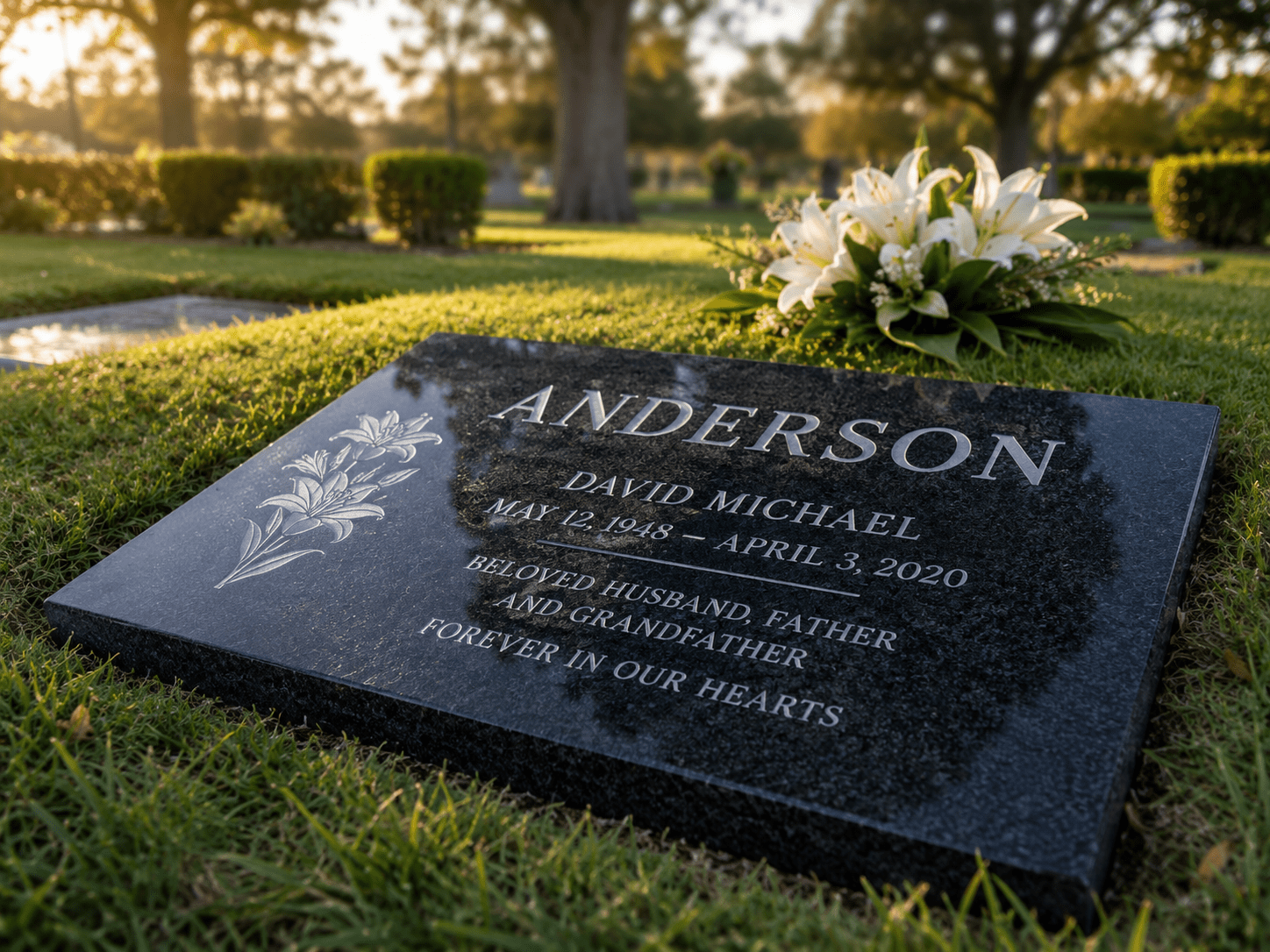
How Granite Compares to Other Flat Headstone Materials
If you are wondering whether another material might serve just as well as the best material for a flat headstone, it is worth understanding what the realistic alternatives actually look like in practice after years of cemetery exposure.
Does Marble Hold Up as Well as Granite for Flat Markers?
Marble is beautiful when new, and for upright monuments in protected settings it can remain presentable for generations. For flat headstones and ground-level grave markers, it is a different story entirely.
Marble is calcium carbonate, which means it reacts chemically with acidic rainwater and environmental pollutants. Over time, the surface of a marble flat marker begins to dissolve at a microscopic level, which first softens the texture, then erodes inscriptions, and eventually leaves the surface rough and pitted. Flat markers face more direct water exposure than upright monuments, which accelerates this process.
You have probably seen marble headstones from the 18th and 19th century in older cemeteries where the inscriptions are barely readable. Most of those are marble. The granite markers from the same era are still clear.
How Does Bronze Compare to Granite for Flat Cemetery Markers?
Bronze flat markers are the other common option, particularly in veteran cemeteries and well-maintained memorial parks. They have real advantages, including a formal appearance and compatibility with flush-to-grade cemetery requirements. But bronze is a different product category with different tradeoffs.
Bronze markers are typically mounted on a concrete or granite base, require periodic cleaning to prevent oxidation staining, and are generally more expensive than granite alone when the base is factored in. They also cannot accept portrait engraving the way granite does, which matters to many families.
For families who want portrait etching, detailed artwork, or a design that can be customized with photographic likeness, granite is the only material that fully delivers on all of those requests.
What About Concrete, Fieldstone, and Other Materials?
Concrete markers and natural fieldstones have been used historically, particularly in rural cemeteries, but neither is considered a viable option for a new permanent memorial. Concrete absorbs moisture, cracks under freeze-thaw pressure, and cannot hold engraving with any durability. Fieldstone is inconsistent and unworkable for custom inscriptions. Neither meets the standards that modern cemeteries require.
|
Material |
Hardness |
Weather Resistance |
Engraving Quality |
Longevity |
Portrait Capable |
|
Granite |
High |
Excellent |
Excellent |
100+ years |
Yes |
|
Marble |
Medium |
Poor for flat markers |
Degrades over time |
40-70 years visible |
Limited |
|
Bronze on granite base |
N/A (metal) |
Good with maintenance |
Text only |
Long with upkeep |
No |
|
Concrete |
Low |
Poor |
Poor |
20-40 years |
No |
Which Type of Granite Works Best for a Flat Cemetery Marker
Not all granite is identical, and the color and finish you choose affects both the visual result and the practical performance of the marker over time.
Why Black Granite Is the Most Popular Choice
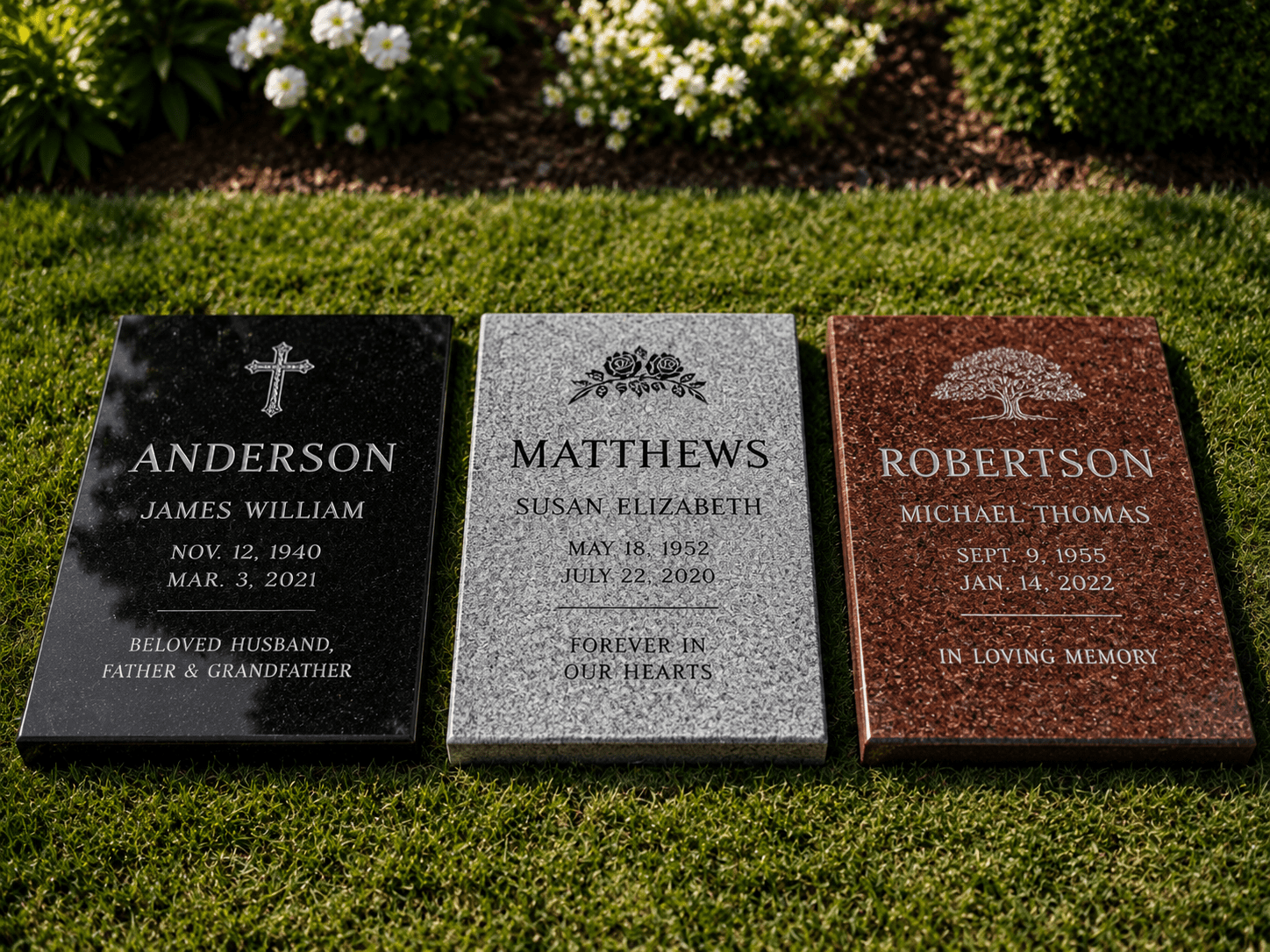
Black granite, typically gabbro or absolute black varieties, is the most widely chosen material for flat headstones and upright memorials alike. The reasons are practical as much as aesthetic.
The dark background creates maximum contrast with light-colored engraving, which means lettering and portrait etchings remain highly visible even as the stone ages. Black granite also accepts the finest detail work from laser and sandblast engraving, which makes it the preferred surface for portrait etching and intricate artwork.
If the person you are memorializing would want their likeness preserved as part of the stone, black granite is almost always the right choice for the background material.
Grey Granite for a More Traditional Look
Grey granite, which includes the widely used Balmoral, Bethel White, and similar varieties, gives a softer, more traditional appearance that works well for classical memorial designs. It tends to complement older cemetery environments and pairs naturally with religious symbolism, floral designs, and understated inscriptions.
The contrast for engraving is slightly lower than black granite, but text remains fully legible and the material performs identically in terms of weather resistance and durability.
Red and Colored Granite Options
Red and multicolored granite varieties, including Imperial Red and Mahogany, offer a visually distinct memorial that stands apart from the more common black and grey options. Many families choose colored granite to reflect the personality of the person being memorialized, or simply because it aligns with personal preferences.
Red granite performs identically to other granite varieties in terms of durability and engraving capability. The color is natural and stable, not applied or treated.
How Long Does a Granite Flat Headstone Actually Last
A properly crafted granite flat headstone, installed correctly and made from quality stone, can remain in legible, presentable condition for 100 years or more. Some granite memorials from the 19th century are still perfectly readable today with no restoration.
The variables that affect longevity most are:
- Stone quality. Quarry source and density vary. Lower-density granite absorbs slightly more moisture and shows surface wear sooner.
- Installation method. A flat marker that is properly set on a concrete foundation sits stable and drains water away from the surface. A poorly set marker that shifts or traps water underneath deteriorates faster.
- Finish type. Polished granite maintains its surface better than rough or sawn finishes because the polishing process closes surface pores and creates a more water-resistant layer.
- Climate. In freeze-thaw climates, the number of annual temperature cycles the stone experiences affects long-term surface integrity, though quality granite handles this well.
For practical purposes, if you are choosing a granite grave marker for a loved one, you are choosing something that will remain in the family and visible to future generations indefinitely. That permanence is part of why the material matters.
What Can Be Engraved on a Granite Flat Headstone
The engraving options on granite are considerably more flexible than most families realize when they start the process. Granite accepts everything from simple text to highly detailed portrait reproductions, depending on the engraving method used.
Text, Dates, and Inscriptions
The foundational elements of any flat headstone. Names, birth and death dates, and personal inscriptions are sandblasted or laser-etched into the polished surface with precision. On quality granite, these inscriptions remain sharp and readable for generations without retouching.
Portrait Engraving on Black Granite
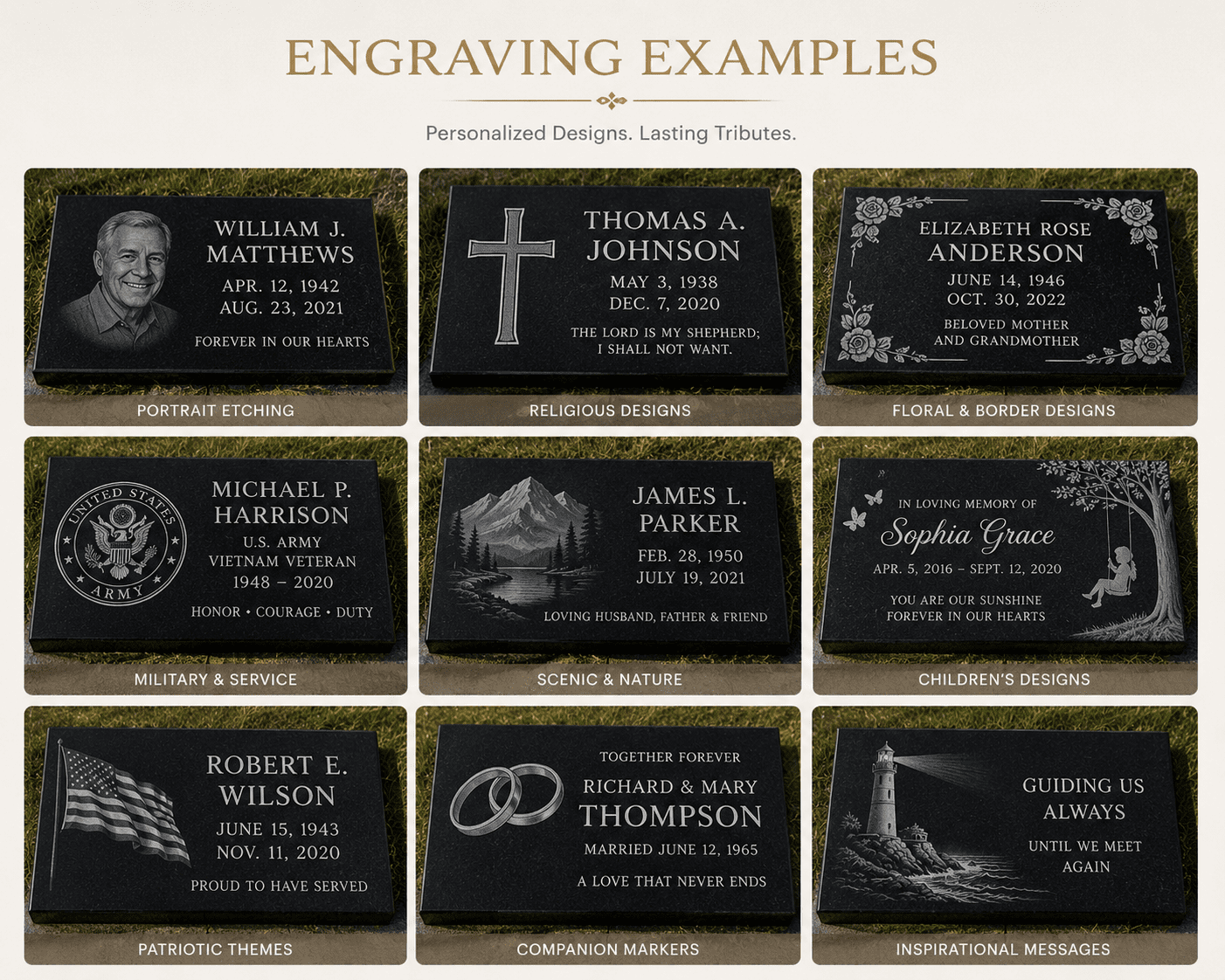
One of the most meaningful options available on a granite flat headstone is a photographic portrait etched directly into the stone. Using a reference photograph, skilled engravers recreate the likeness of the person being memorialized in fine detail on the granite surface.
This is only achievable on granite, and specifically works best on black granite because of the tonal contrast available in the material. The result is a permanent visual record of the person that becomes part of the memorial itself.
Religious Symbols, Military Insignia, and Custom Artwork
Granite accepts virtually any artwork that can be reduced to an engraving file, including religious symbols across all faiths, military branch insignia, nature imagery, and custom designs that reflect a person’s life or interests. Many families incorporate imagery that speaks to who the person was, whether that is a specific flower, a musical instrument, a sports symbol, or a scene from nature they loved.
Why So Many Cemeteries Require Granite Specifically
If you have already spoken with the cemetery where the marker will be placed, you may have noticed that many of them specify granite by name in their regulations. This is not arbitrary.
Cemeteries maintain specific material standards for several reasons:
- Groundskeeping compatibility. Flat granite markers allow lawn mowers and maintenance equipment to pass over them without damage, which is a practical requirement in maintained memorial parks.
- Long-term maintenance burden. Cemeteries that permit lower-quality materials end up with deteriorating markers that become eyesores and require removal or replacement decades later. Granite avoids this problem.
- Appearance standards. Many cemetery associations and military burial grounds have formal appearance standards that granite satisfies but softer or inconsistent materials do not.
- Structural requirements. Some cemeteries require stones above a minimum thickness and hardness to ensure they do not crack, shift, or sink irregularly over time.
Before ordering, confirming the cemetery’s specific requirements for dimensions, thickness, and finish is an important step. We assist with this as part of the ordering process so families do not encounter a compliance issue after the marker is made.
What Does a Granite Flat Headstone Actually Cost
Granite flat headstone pricing varies based on size, granite color, engraving complexity, and the supplier you are working with. Here is a realistic range based on the market:
|
Marker Type |
Typical Price Range |
|
Small single flat marker (standard size) |
Starting around $200 to $350 |
|
Standard single flat headstone |
$300 to $700 depending on complexity |
|
Companion flat headstone (two names) |
$450 to $1,000 and above |
|
With portrait engraving |
Additional cost depending on complexity |
|
Premium granite colors (imported varieties) |
Higher than domestic equivalents |
At Capital Grave Markers, engraving is included in the price of every marker. There are no separate engraving fees added at checkout. A porcelain photo is also included at no extra cost for families who want a photographic element on the marker without committing to a full portrait etching.
Shipping is included nationwide, which is a meaningful difference from suppliers who add delivery charges after the fact. For families working within a specific budget, 0% installment plans are available up to 12 months, and financing extends to 24 months for those who need more flexibility.
Veterans receive a 30 percent discount, first responders and those in dangerous professions receive 15 percent off, and families purchasing two or more markers save 25 percent. Paying in full at the time of order saves an additional 25 percent off the listed price.
What to Watch Out for When Ordering a Granite Grave Marker
Many families order a flat headstone once in their lives and have no reference point for what a quality supplier should provide versus what to be cautious about. Here are the things worth paying attention to:
- Hidden engraving fees. Some suppliers quote a base price and then charge separately for each line of text, the artwork, and any portrait work. Ask explicitly what is included before placing an order.
- Unclear timelines. A supplier who cannot give you a committed completion date is a risk, especially when cemetery placement is time-sensitive. A 60-day completion guarantee, as we provide, gives you a firm reference point.
- No design preview. You should never approve a headstone without seeing exactly what will be made. A 3D design preview with revision rounds protects you from receiving something that does not match your expectations.
- Stock limitations. Some suppliers quote long lead times because they are working with limited granite inventory. Our stock of over one million pounds of granite allows us to fulfill orders on a consistent and predictable timeline.
- Imported stone with inconsistent quality. Not all granite is equivalent. Knowing where the stone originates and whether the finishing work is done domestically matters for quality assurance.
If you are ready to start the design process or just want to see what the finished marker would look like before committing, fill out the consultation form on our contacts page or call us at (888) 241-1701. The free 3D design preview is available at no cost with two revision rounds included.
How Capital Grave Markers Handles the Granite Flat Headstone Process
At Capital Grave Markers, we have built our process specifically around removing the uncertainty that families face when ordering a memorial for the first time. We understand that this is not a routine purchase, and the decisions involved carry real emotional weight.
Every order includes a free custom design preview before production begins. You will see a 3D representation of the finished marker with your specific engraving, artwork, and any portrait elements, and you can request revisions until the design is exactly right. Nothing goes into production until you have approved it.
Our engravers are based in the United States and finish each marker by hand with the precision that a permanent memorial requires. The stone comes from our stock of over one million pounds of granite in black, grey, and red varieties, which is what allows us to commit to our 60-day completion guarantee.
If you are choosing between a single flat headstone for an individual or a companion flat headstone for two, both are available across all granite colors and with the full range of engraving options. You can browse the full collection on our flat headstones page or explore our complete products catalog for other memorial styles if a flat marker is not the right fit for your situation.
We also offer a 10 percent price match guarantee if you find a comparable marker from a competitor at a lower price. The goal is to make sure the decision comes down to what is right for the person you are honoring, not budget pressure.
Frequently Asked Questions About Granite Flat Headstones
Why is granite used for flat headstones instead of other stones?
Granite is used because it outperforms every other natural stone material in the conditions a flat cemetery marker faces. Its hardness, low porosity, resistance to freeze-thaw cycles, and ability to retain fine engraving detail for generations make it the most reliable choice for a permanent outdoor memorial. Other materials like marble erode and lose legibility over time, particularly in flat applications with constant moisture exposure.
What is the difference between a flat headstone and an upright headstone?
A flat headstone, also called a flat marker or flush marker, lies level with or slightly above the ground surface. An upright headstone stands vertically above the grave. Flat markers are required by many cemetery regulations and are common in military burial grounds and memorial parks where a uniform, mowed appearance is maintained. Upright monuments are generally larger and more visible but not permitted in all cemetery sections.
How thick should a granite flat headstone be?
Most cemeteries require a minimum thickness of 3 to 4 inches for flat granite markers. The specific requirement varies by cemetery, which is why confirming the regulations before ordering matters. Markers that are too thin may not meet compliance standards or may be more vulnerable to cracking under ground movement over time.
Can you add a photo to a granite flat headstone?
Yes. Granite flat headstones can include portrait engraving etched directly into the stone surface, or a ceramic porcelain photo mounted to the marker. Portrait engraving works best on black granite because of the tonal contrast. Ceramic photos are color and weather-resistant, and Capital Grave Markers includes a porcelain photo at no extra charge on every order.
What size is a standard flat headstone?
The most common standard size for a single flat marker is 24 inches wide by 12 inches tall, with a thickness of 3 to 4 inches. Companion flat markers for two individuals are typically 24 by 12 or larger depending on the design. Cemetery regulations vary, so confirming the permitted dimensions with the specific cemetery before ordering is an important first step.
How long does it take to receive a granite flat headstone after ordering?
At Capital Grave Markers, we guarantee 60-day completion on all orders. Many orders are completed and shipped before that window depending on design complexity and the specific marker. The timeline begins after your design is approved, so finalizing the design promptly helps move the process forward.
Is engraving included in the price of the marker?
At Capital Grave Markers, yes. Engraving is included in the listed price with no separate fees for text, dates, or standard artwork. This is not the case with all suppliers, so it is worth confirming explicitly when comparing quotes.
What granite color holds up best over time outdoors?
All granite colors perform comparably in terms of durability and weather resistance. Black granite tends to hold its surface appearance most visibly over time because the polished dark surface shows less environmental staining than lighter varieties. Grey and red granite are equally durable but may show some surface variation over decades in harsh climates.
Can a granite flat headstone be placed on any grave?
Not all cemeteries permit flat markers in every section, and some sections require flat markers exclusively. You will need to confirm with the specific cemetery what marker styles, sizes, and materials are permitted in the plot where the memorial will be placed. We assist with this step as part of the ordering process.
Is it possible to order a granite flat headstone on a payment plan?
Yes. Capital Grave Markers offers 0% installment plans up to 12 months and financing options up to 24 months. Veterans receive a 30 percent discount, first responders and those in dangerous professions receive 15 percent off, and paying in full at the time of order saves an additional 25 percent. Call (888) 241-1701 or fill out the form on our contacts page to discuss the options that fit your situation.
