

Element by Element: One Stone, a Virgen de Guadalupe Headstone

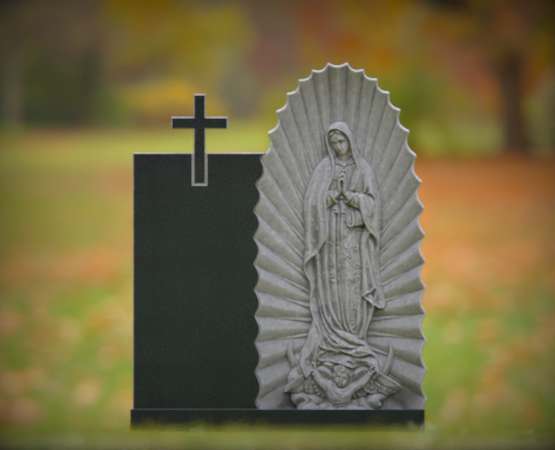
Good evening, lights down, please, and thank you for coming. For this lecture, we have selected the composition of one single monument: an imaginary Guadalupe monument made from all those our workshop has created for Hispanic families from California, Texas and Florida, projected here element by element, just as art history looks at an altarpiece. This is fitting in this case, as a good Virgen de Guadalupe headstone is an altarpiece in itself, designed according to rules older than any of us. A family commissioning such a monument deserves to be informed about all the elements involved and what “correctly carved” means. Seven slides. Questions at the end, please. First slide, please.
Slide one: the whole stone, viewed from visiting distance. Before the details, the composition. The composition of our composite monument is a vertically-oriented headstone of polished black granite, the material of choice for this iconography – and not for fashion reasons, as the original image of Guadalupe stands against the darkness lit from within, and black granite helps it to shine as it was supposed to. Notice the hierarchy of the design, apparent even from a distance: the Virgen standing at the upper field, the family inscription field below, the roses climbing along the margin. Nothing is overcrowded. The first rule of the design tradition behind this composition, stated before we zoom in: the monument is a devotional composition, not a collection of motifs, and every element to be looked at today has its assigned role in it.
Slide two: the Virgen de Guadalupe herself. Central image, and a stop of some length for this presentation, as in this case reverence and craft are one and the same. The iconography is determined by its source – the miraculous image of Guadalupe preserved since 1531 in the tilma at Tepeyac – and it is known by heart by the families. The Virgen standing, her head inclined, her hands joined; the mantle falling over her hair and shoulders; her figure being fully enclosed by the mandorla of rays. To carve it correctly means to pay homage to the canon: the inclination of the head (always to her right), the join of the hands, the fall of the mantle. We render her image in deep carving or fine etching depending on the size of the monument, and the design proof – presented to the family at its real size in the free 3D design preview – is where grandmothers, who are the sternest and the most competent critics of this iconography, check the details. Lecture notes for the trade: when abuela nods her head, the carving is done right, and never before.
Slide three: the rays. Surrounding the figure: the mandorla – or the almond of the rays, alternating straight and flamed shapes – the element which defines the image as an apparition, not a portrait. On granite, it is the technical highlight of the design: every ray is cut individually, the rhythm of it is regular, and its lengths are varied to produce the aureole swelling at the mid-point of the figure. Craft point for slide three: cheap renderings reduce the number of rays – there are fewer of them, they are less sharp, their rhythm is irregular – and the eye immediately notices it, even the eye not capable of saying why. Count the rays on a proof. The tradition required it.
Slide four: the mantle of stars. Closer still: the Virgen’s mantle, blue-green in the original image, carried by the stars scattered along it – the eight-pointed stars which puzzled the scholars for centuries in their pattern of placement on the original tilma. On the stone, the stars are small, precise, and irreplaceable: a starless mantle is a coat, not the sky. Etched fine on polished black surface, they do quiet work after dusk, as a Guadalupe monument becomes a part of the night it depicts. Families sometimes ask for a certain star to be slightly raised for a private reason – to mark a birth date, or to remember a particular evening – and we comply with this request without comments. There has always been room in the tradition for the family’s own astronomy.
Slide five: the roses. Descending the composition: the roses of the margin, growing along the stone’s shoulder to meet the Virgen – Castilian roses, the flowers of the miracle, gathered in December on Tepeyac when there should be no roses. On the monument they fulfill three functions at once: they narrate (every viewer versed in the tradition reads the story in them), they frame (guiding the viewer’s eye from the field of the family names to the figure of the Virgen), and they personalize – carved fuller for a grandmother who grew roses, budded for a child, opened wide for a matriarch. Deeper carving, and not the shallow etching, pays for itself here, as roses need the shade. Slide five’s family note: this is the element most often left to the family’s instructions, and the proofs are revised until the roses become theirs.
Slide six: the inscription field. Below the devotional field – the field of the family names and dates, and here we will address composition in two languages, because this Guadalupe monument is overwhelmingly a bilingual monument. The tradition’s best examples combine Spanish and English into one design: the Spanish carries the intimate register – Recuerdo de tu esposa e hijos; Descansa en los brazos de la Virgen – the English carries the names and the dates, for the civic record, and for the grandchildren’s schooling, both of them weighted deliberately, neither of them an afterthought. Our standard procedure fully applies here: Spanish inscriptions composed and then reviewed by native readers before production, including accents – the tilde is not a decoration, and the language deserves the same reverence as the image above it. Design point for slide six: leave the field airy. The tradition’s crowded examples fail here exactly; the best ones let the names breathe under the rays.
Slide seven: the stone at work. Final slide: the monument pictured not in the workshop but in operation – cempasúchil at its base in November, a rosary looped over the shoulder after a novenario, the polished black stone bright from the family’s washing before December 12th, the Virgen’s feast day, when the Guadalupe monuments across the country receive their annual crown of visitors. This is the thesis of this lecture: this design tradition does not consist in decoration added to the stone, but in infrastructure which enables the life of devotion to continue at the grave – the visits, the feast days, the introduction of the new grandchildren to la Virgen and the name below Her in one gesture. A monument built for that kind of life requires the combination of the elements assembled tonight: correct iconography, craft depth, two-language composition with native reader reviewing, polish which will withstand washing, and granite capable of maintaining the rhythm of the rays for the great-grandchildren’s visits. Our workshop builds monuments to that standard routinely – full free 3D previews and revisions until the family and its sternest reviewer approve, engraving included in every listed price, shipping free, cemetery requirements checked with the office beforehand, 0% plans available. And we consider this design tradition, without reservation, the most difficult and rewarding work on our benches.
Lights up. The lecture’s closing sentence is a quote from a client, a grandmother, who checked the design proof for some time, touched the screen where the rays met the roses, and gave the review this whole tradition has been carved for: “Ella está bien hecha. Ahora mi esposo tiene compañía.” She is well made; now my husband has company. Questions are welcome, and the workshop is open. Thank you.
