

The Pebble, the Matzevah, the Letters, the Cloth, the Candle: Jewish Headstone Traditions in Five Objects

There are traditions where the best introduction comes in form of objects – tangible items a visitor may touch – and there are few memorial traditions with such elegant objects as the Jewish cemetery. Walk the grounds of any Jewish graveyard and five of them will explain everything you need: the stone left on the shoulder of a monument, the monument itself, the letters inscribed in two alphabets, the cloth you will see only once, and the candle that will burn at home. This essay goes over the Jewish headstone traditions in that particular order – five objects put under the spotlight – to enlighten both the curious visitor and the Jewish family planning a monument: we are honored to serve the latter, so we wrote this for the former.
Object one: the pebble. Start with the smallest and the most moving for the uninitiated object. On the crown and shoulders of Jewish headstones there are small pebbles left by visitors, sometimes in a scattering way, sometimes accumulated for decades. Rarely are flowers used – mostly stones. There are several explanations of the tradition and they are all equally beautiful: that stones, as opposed to flowers, are everlasting, so are honest offerings of permanence; that they are reminiscent of desert cairns used to mark the graves during the days of wanderings; that each stone is a calling card – someone was here, you are not forgotten – accumulating into a visible tally of remembrance. What the visitor should know: leaving a pebble is appreciated by anyone visiting respectfully. What the family planning a monument should know practically: the tradition encourages monument designs that feature accessible horizontal surfaces – level crown, shoulders, a base ledge – and granite takes decades of resting stones without a mark. Our monuments are designed with pebbles in mind, because a Jewish monument’s crown is not just empty space: it is a guestbook waiting to be signed.
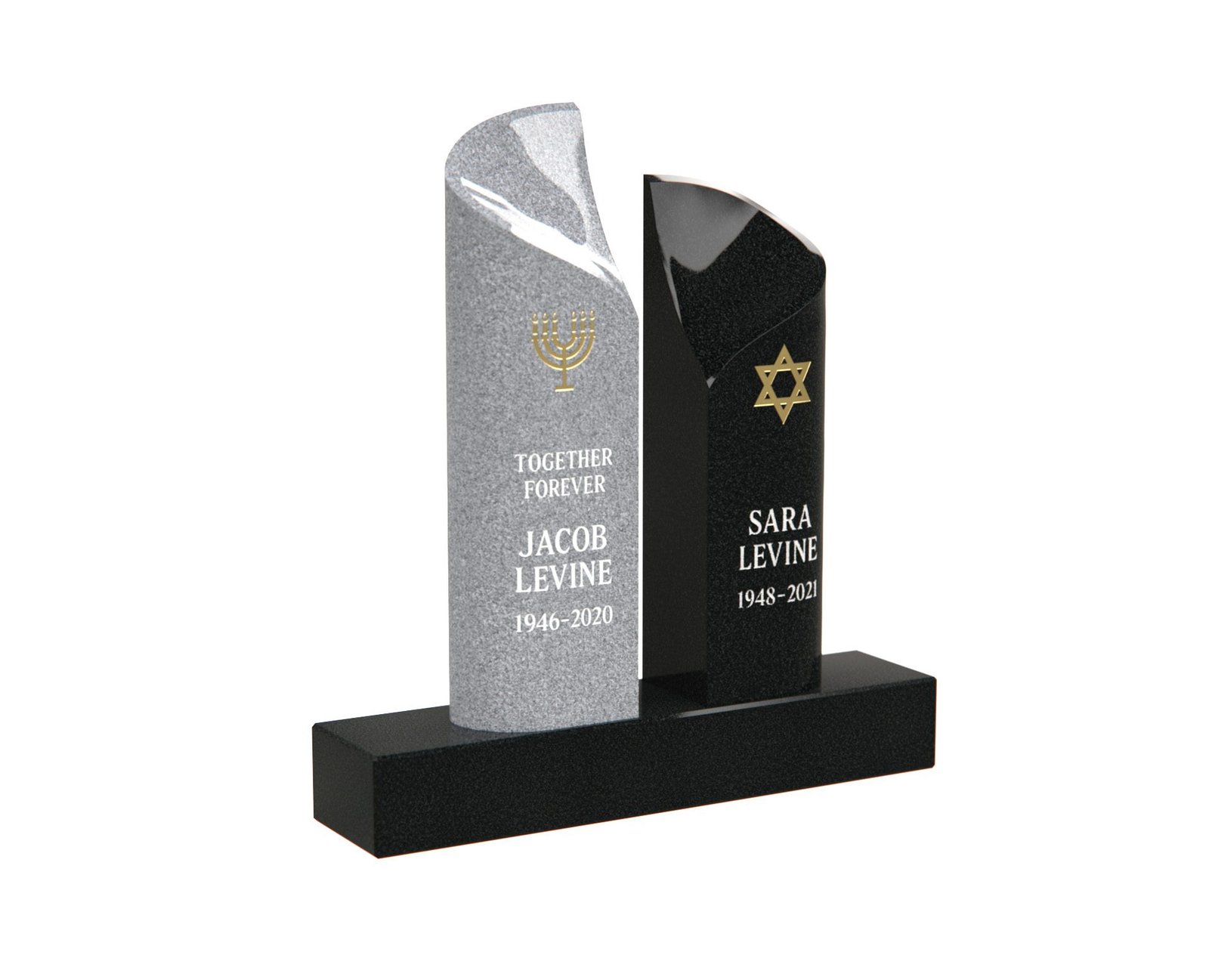
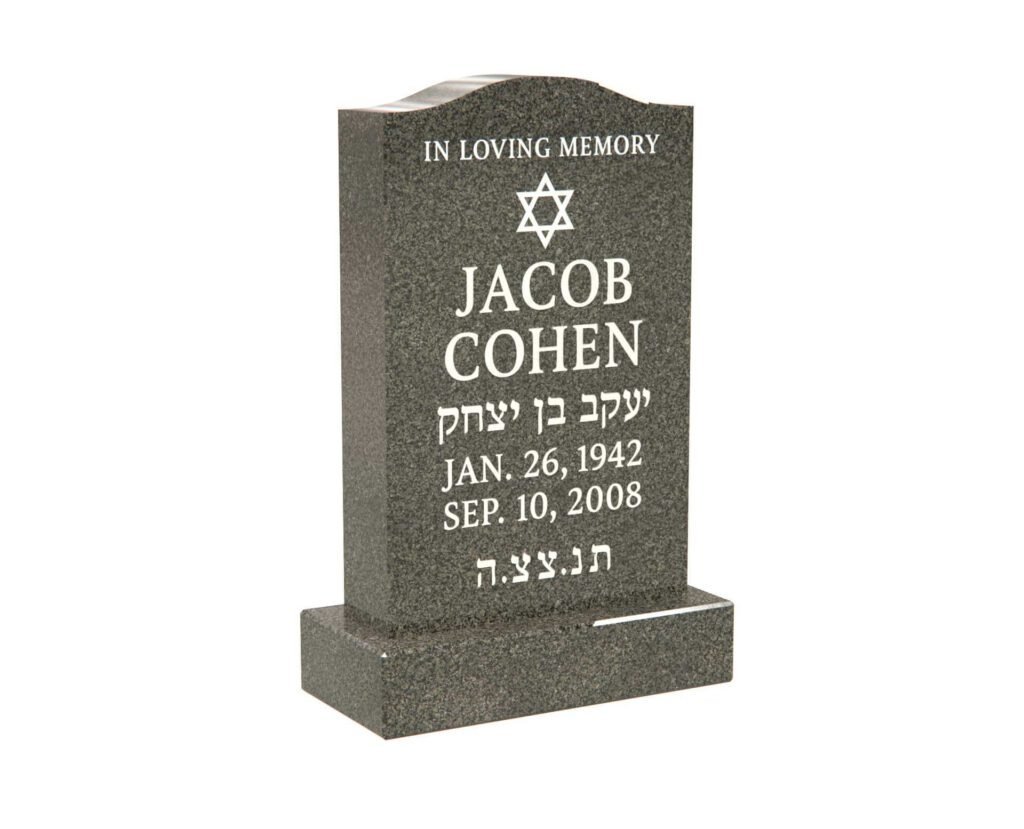
Object two: the matzevah. The monument itself, and the word is crucial: matzevah – the standing stone – a word as old as Genesis, where Jacob leaves one over Rachel’s grave on the road to Bethlehem. The tradition it names is one of the most ancient practices of human memorial: the grave marked with upright stone, the name kept alive, the place reachable for generations. The form of the monument varies according to community custom rather than strict laws – upright tablets prevail in traditional grounds, while flat and slant markers are used where required by the cemetery; ornamentation is also restrained: Star of David, two-letter abbreviation po nikbar (“here lies”) at the crown, for descendants of the priestly line hands of the kohanim, for a Levite family a pitcher, sometimes tree of life or a candelabrum for a woman of valor. The restraint is the essence of the aesthetic – the matzevah trusts the name. Our workshop’s practice observes the vocabulary of the tradition – correct symbols, correctly drawn, in granite formats meeting each cemetery’s and community’s standards, checked by the office and, upon request, by the rabbi before design.
Object three: the letters. Two alphabets are inscribed on most American Jewish stones, and the combination of them is the core of the design. The Hebrew inscription traditionally carries the Hebrew name – the name by which a person was called to the Torah, child of their father and mother – with dates in the Hebrew calendar, and finishes with five letters translating for every visitor as “may their soul be bound up in the bond of life”. The English carries the civil name and dates. The question of the composition – which alphabet should lead the inscription and how the two should divide the stone – is the prerogative of the family and their community’s custom; the question of accuracy is the entire responsibility of the workshop, and here our rule is absolute and worth stating publicly: every Hebrew inscription we cut gets reviewed by native speakers before production, letter by letter, including vowel points where applicable, because the mistake in a name meant to last centuries is not just a typo, it is an injury. We get the Hebrew from a ketubah, a bar mitzvah certificate, a parent’s memory, and set it, prove it in the free 3D preview of the monument, then have it checked by fluent readers before granite finds out about it. It is not an extra service. It is the minimum requirement of the assignment.
Object four: the cloth. The object to be seen only once: the veil that covers the newly built monument during the unveiling ceremony – a uniquely American Jewish practice, traditionally taking place within the first year of mourning, usually around eleven months, when family members come to the grave, psalms are read, mourner’s kaddish is recited in the presence of a minyan, and the cloth is removed to unveil the new monument. The unveiling ceremony is the calendar for the monument-building process, and a workshop serving Jewish communities needs to honor that as a hard deadline: our production planning schedules backwards from the unveiling date, having the design and native speakers’ check done so that the matzevah can stand ready to be inspected before the invitations are sent out. The families tell us that for them the moment of unveiling is the point where the loss becomes real and bearable – the name on the stone surrounded by the community – and being always ready for that moment is the most important delivery promise in our calendar.
Object five: the candle. The last object is burned at home: the yahrzeit candle, lit every year on the Hebrew anniversary of the death for twenty-four hours of remembering. It needs to be mentioned here because it completes the architecture constructed by the other four objects: the tradition divides the memorial process between the cemetery and the household – the matzevah carries the name in public permanence; the candle refreshes it privately every year, eternally. Families usually visit the grave during the yahrzeit season and before the High Holy Days, bringing their pebbles along, and the cycle closes: stone, letters, visit, candle, year after year. A monument builder’s role in that architecture is humble but exact – make the public half worthy of the private half’s devotion.
The final word of this essay. Five objects, one tradition, and for the planning families, one practical paragraph: our matzevot are granite monuments in upright, flat, slant and double formats meeting community and cemetery standards; Hebrew and English inscriptions combined in one design with native speaker’s review as standard; correct symbolic vocabulary; adherence to the unveiling date scheduling; the free 3D preview and included revisions for the family’s – and, if required, rabbi’s – approval; engraving included in every price, delivery covered, and 0% installment plans available, with pre-need arrangements for the planners. The pebbles, the visits, the candle – these are the responsibility of the family and the community, as it has been for three millennia. The stone that receives them is our craft, and we cut it to be worthy of its guestbook.
