

The Flat Files: Drawer By Drawer Look Inside Our Collection of Every Headstone Drawing We Keep

In the corner of our design studio sits a wide flat file cabinet, containing shallow drawers full of something that nobody ever photographs at monuments: drawings. Every stone that we make generates its own collection of headstone drawing stages along its journey from the family’s first sketch through all the stages of design up to engraving. Families are often surprised by the drawings’ existence; they assume granite goes from grief straight to the engraver’s hands. But that is not how it works, and the gap between the two is filled by the drawings, each hand-drawn and computerized step by step. So today the cabinet is open for business. A tour through our collection, drawer by drawer – what each of these drawings represents, who draws it, and why your stone will look better because of them all.
Drawer number one: the kitchen drawings. In the top drawer we keep drawings brought to us by the families – the studio’s favorite drawer unanimously voted so. Ballpoint drawing on notebook paper. Marker layout on the back of a funeral program. One perfect ruler-drawn design for his own pre-planned stone, drawn by a retired machinist with his measurements in thousandths. They come to us apologized for – “I’m not an artist”. The studio’s reply to this is pinned right inside the drawer: a family’s headstone drawing is not just a sketch; it is a certificate of birth for the design. This is where we can tell a lot of things about the proportions, placement of elements and which words were written the biggest. We keep every single one of these, and more of them end up in the final stone than the families expect. If you’re planning a memorial stone, draw your kitchen sketch first. You can’t draw it wrong; you can only draw it yours.
Drawer number two: the concepts. Designer’s interpretation of drawer number one: a couple or three rough sketches based on the materials provided by the family, trying to figure out a solution for the task. These are the drawings to be discussed and, thus, these have their traces of being argued with. The studio rule for every designer here is simple: don’t show one concept. One drawing is meant to get approved, while two or three – to get discussed. And discussions bring the person into the stone.
Drawer number three: the scale cartoon. Trade’s old and elegant term for the full-size working drawing, a “cartoon” in a sense of fresco painter. Here the concept is sketched down at the exact scale of the stone, every letter placed, every emblem sized and placed and spacing resolved to the eighth of an inch. This is where all the problems appear: a verse that looked nice enough at the note scale becomes crowded, an emblem gets two more inches and the name its final letter height – those are the decisions that could only be done at true size. That is why the cartoon stage has existed in every stone workshop since the pattern-book days. Families rarely see the cartoon drawing but feel it – stones missing the drawing always look subtly wrong forever, and nobody can tell why.

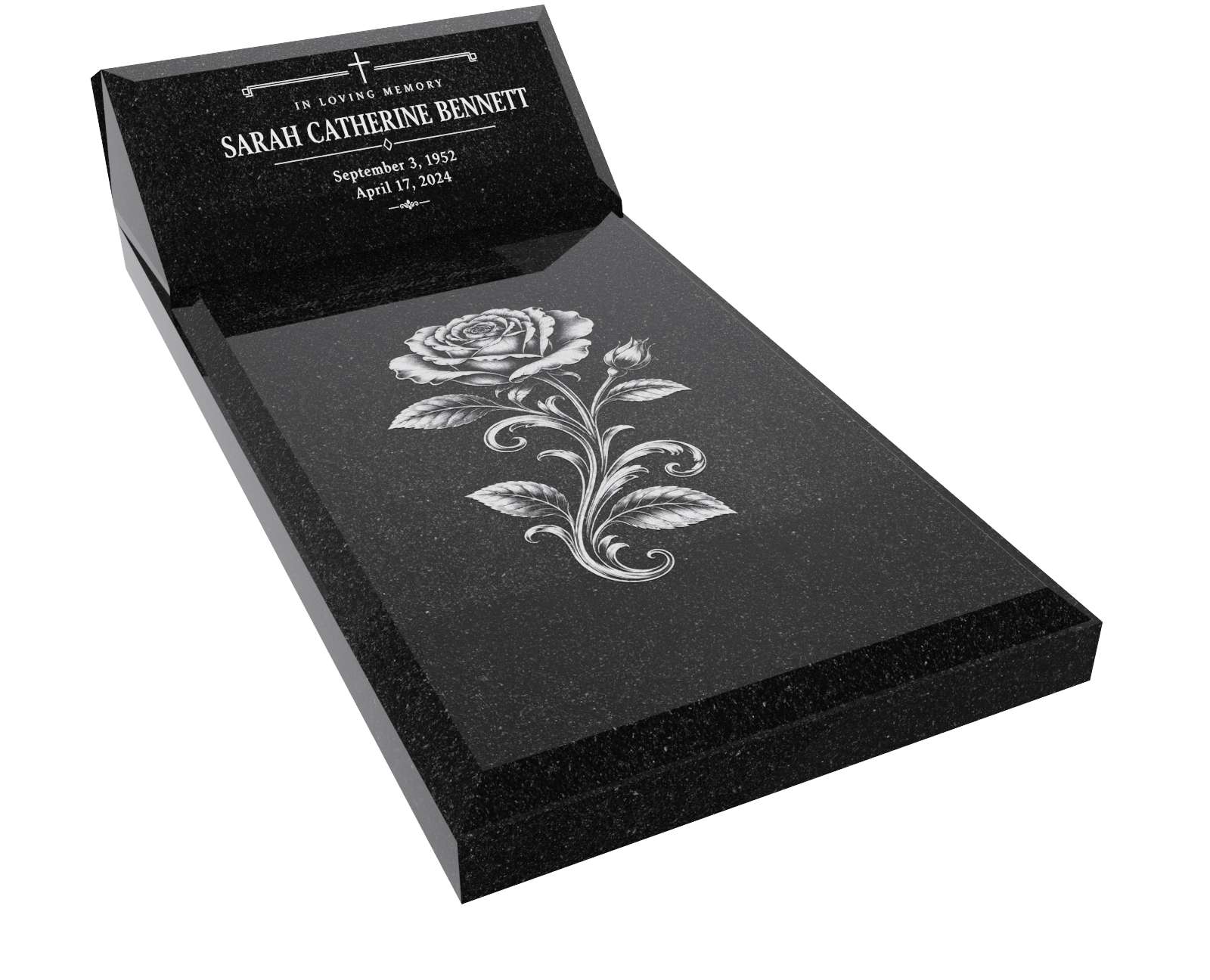
Drawer number four: 3D render proofs. The most recent addition to the cabinet, and the drawer the families know best: free 3D design preview, your granite color and finish with the entire inscription sketched down at the visitor’s eye height. The studio treats this drawing in the same way as the kitchen drawing: to be taken to discuss in real scale and revise until the family falls silent – and that is when designers know it’s done. The oldest proofs in the drawer are now a decade old – we keep them for the future day we’ll need to match a companion’s inscription. It’s an archive that is there to promise and not to store papers.
Drawer number five: stencil layouts. The very last drawing generated by the stone and the only one applied directly to it: the production drawing from which the engraving stencil will be plotter-cut – every letterform ready, every line drawn the exact way it will be engraved in granite. This drawer contains the strictest check culture in the studio – layout against 3D proof against order paperwork, letter by letter, with the production halted if there are any discrepancies however small, since this drawing is the one that can’t be revised. The drawer’s discipline guarantees that the stone will contain exactly what was approved – and this is why our engraving, included in the price, won’t surprise anybody.
Bottom drawer: the ones we keep for ourselves. Every studio has it. The drawing made by a father with his daughter the week before he passed away, their hands on the same page becoming the design and the epitaph. Five-year correspondence of sketches with a widow who revised the inscription on her husband’s stone to perfection, like a poem. The crayon sketch added to the drawing at the counter by the grandson, which the family insisted stay in the border. The studio shows this drawer to new employees on their first day, even before any training, to help them understand the actual contents of the cabinet. Not drawings. Love’s decisions made in graphite on whatever paper was handy.
Closing the cabinet. The tour has finished right where your stone will start: with the top drawer open, waiting for the kitchen sketch. Draw it tonight – the layout that your instinct already knows, words largest where they matter – and bring it to your consultation, where our flat files will take it further: concepts to discuss, scale cartoon at the true size, free 3D renders to revise till the family goes silent and the checked stencil layout to the engravers. Cemetery regulations are sorted with your office prior to the drawing stages; shipping is free; 0% installment plans keep the timeline the family’s own. Granite receives all the credit at the cemetery, and granite deserves it. But somewhere in a wide cabinet of shallow drawers, the whole process was decided in pencil first – and that drawer, like the stone, is permanent.
